
3-Day Mexico City Itinerary for Day of the Dead
Last year, one of my friends (finally!) came to visit me in Mexico City for Day of the Dead.
I wanted to show her the absolute best time during this magical season — it’s honestly what I look forward to the most every year.
The city is full of sunshine and deep blue skies. Marigolds spill out of every doorway, rainbows of paper picado flutter in the breeze, sweet pan de muerto fills every bakery, and people are celebrating left and right.
If you’re planning to come to Mexico City for the Day of the Dead weekend, here’s the exact 3-day itinerary I created when my friend was in town — and what I’ll use again next year, whether I’m solo or have another visitor.
It includes iconic Día de Muertos experiences like the parade and the Zócalo ofrenda, plus a few low-key local favorites that keep you in the holiday spirit while letting you wander and soak up the magic at your own pace.
If it’s your first time visiting Mexico City, this itinerary will be the perfect introduction.
You’ll get a taste of the most iconic neighborhoods like Roma, Centro, Coyoacán, and Xochimilco, so even in just three days, you’ll see a huge variety of what makes the city so special.
And of course, the city will leave you wanting to come back to dive deeper into each area.

Day 1 – Friday October 30th
Morning – Mercado de Jamaica


For Dead of the Dead flowers by the truckload (like you may have seen on Instagram), you have to go to Mexico City’s flower market, Mercado de Jamaica.
It’s packed the week leading up to Día de Muertos as locals come to the market for flowers, candles, candies, and other goodies for their ofrendas.
I love this market and always take friends or recommend it because it’s such a quintessential Mexican experience.
Make your way through the market maze until you find yourself in the center of the market, where there are flower vendors and their truckloads of bright orange, magenta, and purple flowers.
Last year, I went by Uber, but traffic was a pain, so I took the Metro back home to Roma Norte, and it was quicker. Next time I’ll go by Metro and not mess with traffic.
To get there by Metro: The La Viga stop on Line 8 is right outside the market. From there, transfer at Salto de Agua (where Line 8 meets the pink Line 1), then ride to Insurgentes to get back to the Roma area.
If you want to get to the market from Roma, just follow these directions in reverse.
Sometimes Google Maps gets it wrong so read the Metro map and follow these directions, I promise it’s not complicated.
Afternoon – Mega Ofrenda in the Zocalo
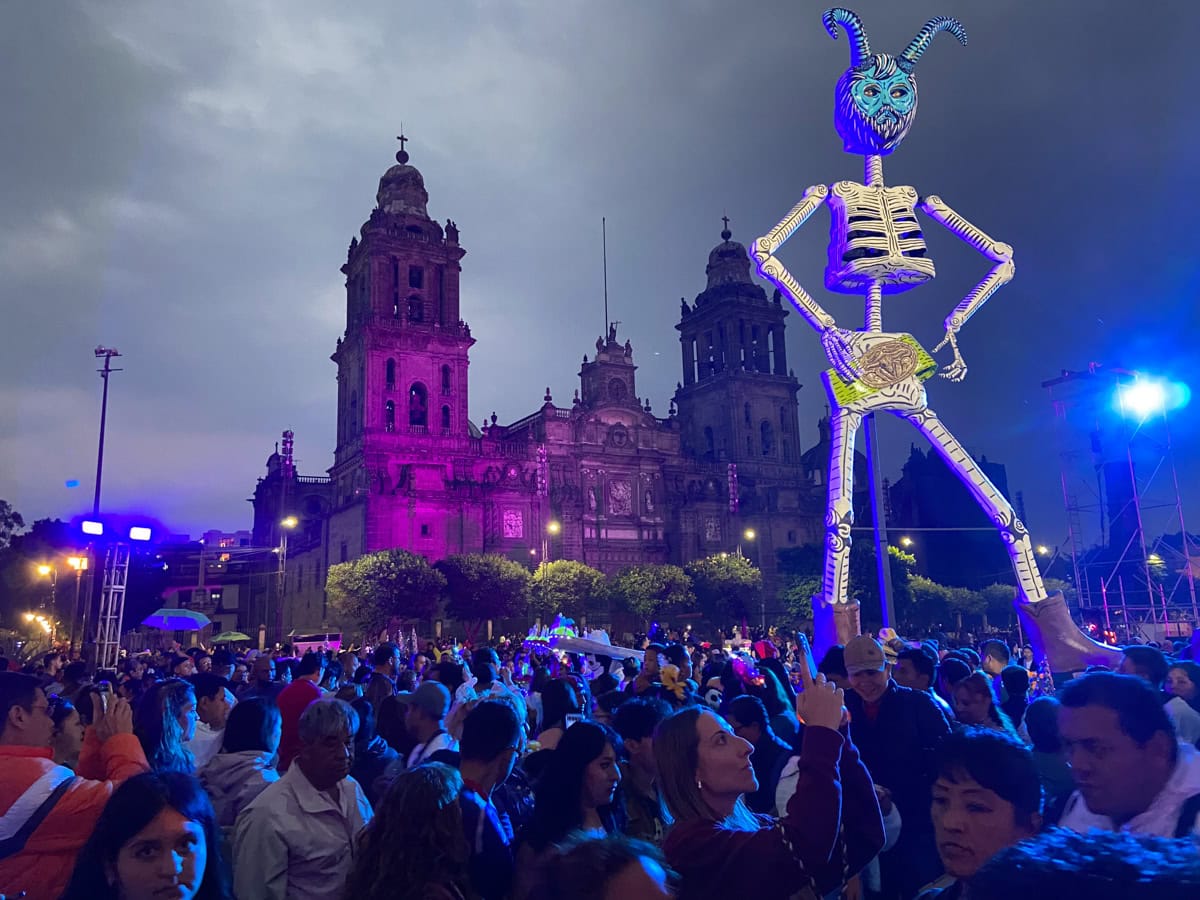
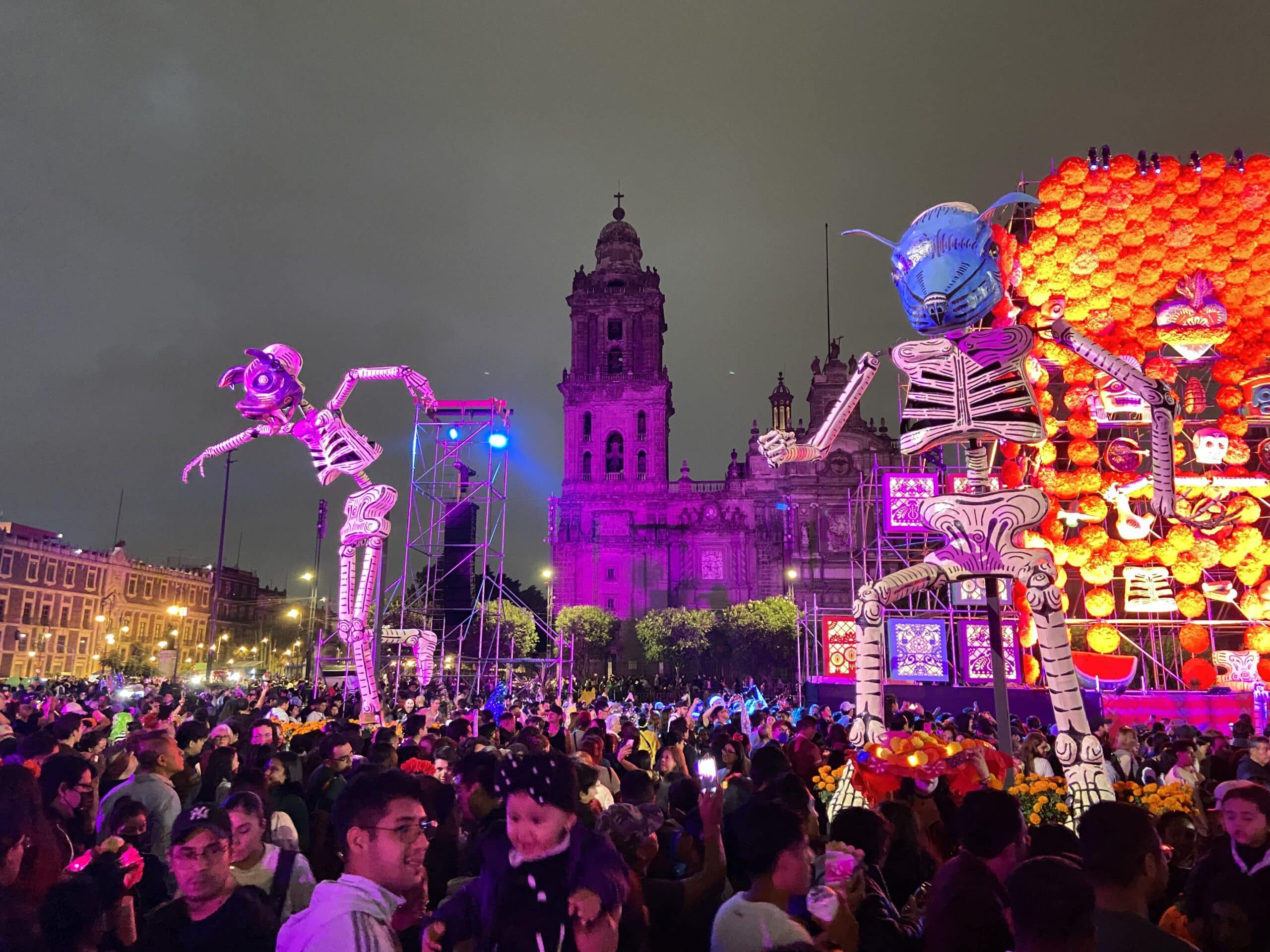
The Zócalo ofrenda is one of the most impressive parts of Day of the Dead in Mexico City — a massive installation that takes over the main square for the week leading up to Día de Muertos.
Each year, it’s completely different, showcasing the work of local artisans through huge papier-mâché sculptures, altars, and symbolic displays – it’s a must-see!
If you only have a few days in the city, I recommend visiting the Zócalo on Friday afternoon, before the Day of the Dead parade on Saturday.
Last time Jorge and I went, we made the mistake of trying to go right after the parade — and it was absolute chaos.
The streets were packed shoulder to shoulder, barely moving, with thousands of people spilling out of Reforma toward the Zócalo. It took us forever just to walk a single block.
To avoid that kind of crowd, go earlier in the weekend when it’s still lively but the crowds are manageable.
Aim for late afternoon so you can see the ofrenda in daylight and then stay until after sunset to watch it light up at night.
Getting there is easy: you can bike using Ecobici (I have a full guide on how to use it here), take an Uber, or hop on the Metro. Any option works — it just depends on where you’re coming from and how much walking you want to do that day.
Evening – Walk Along Reforma

After visiting the Zócalo, head over to Paseo de la Reforma (one of CDMX’s most important avenues) to walk off the day and enjoy one of the city’s best nighttime displays.
During Day of the Dead, Reforma transforms into an open-air art exhibit with colorful lights, giant alebrijes, and painted skulls known as Mexicráneos.
The alebrijes are huge, vibrant papier-mâché creatures — dragons, jaguars, owls, and wild hybrids that look like something straight out of Coco.
Every year, artists from around Mexico compete to create them, and the results are incredible.
There are dozens (if not hundreds) lined along Reforma, along with glowing decorations, souvenir stands, and the occasional face-painting booth.
You can start your walk anywhere along Reforma — from El Ángel de la Independencia up toward La Diana or even further.
The main stretch with decorations usually runs between El Ángel and Chapultepec Park.
From the Zócalo, it’s about 4 km (a little over two miles) to reach that section, so it’s best to take an Uber or bike part of the way using Ecobici.
If you’re staying in Roma, Condesa, Juárez, or Polanco, this is an easy and scenic way to make your way back toward your neighborhood while staying in the festive spirit.
Day 2 – Saturday October 31st
Morning – Coffee, Pan de Muerto, and Roma Shops


Start your Saturday morning slow with a coffee and pan de muerto — the soft, orange-blossom, brioche-y bread that fills every bakery window in October.
I always thought I didn’t like pan de muerto because the ones I had only ever tried were from the grocery store and were dry and very sub-par.
But once I had one from a real bakery, I was hooked.
Last year, I tried pan de muerto from three places: Rosetta, Odette, and Casa 1900.
To no surprise, Rosetta’s version is the priciest. It’s about twice as much as Casa 1900, but the orange flavor is strong, and it’s honestly delicious.
Odette does a fun twist with chocolate cream filling and hazelnuts on top — not traditional, but really good and still cheaper than Rosetta’s plain one.
My favorite, though, is the simple sugar-covered pan de muerto from Casa 1900. It’s the most affordable, tastes classic, and it’s what I kept going back for. (I think I ate like five in one week.)
Pair your bread with a Mexican coffee from a neighborhood coffee shop and take a relaxed stroll around Roma.
On Saturdays, there are bazaars happening nearby like Bazar Reseliente or Bunker Bazaar, where local designers and artisans sell handmade clothes, jewelry, ceramics, and home goods.
You can find some cute, locally made souvenirs here.
Afternoon – Day of the Dead Parade 2pm-6pm


The Day of the Dead Parade is one of the biggest celebrations in Mexico City — 8,000 participants spanning an 8-kilometer route filled with color, music, and tradition.
It starts at the lions gate of Chapultepec and goes all the way to Centro.
You’ll see giant catrinas, papier-mâché skeletons, floats, dancers, and marching bands — it’s over the top in the best way.
Every year, thousands of people line Reforma to watch, and by the time it starts, you’re shoulder to shoulder.
Some people buy little stools to stand on, and others get seats in the bleachers set up along the middle of the avenue.
Last year, we watched from between the Ángel de la Independencia and La Diana — a great stretch with plenty of energy and good views once you find your spot.
If seeing the parade up close matters to you, arrive at least a couple of hours early.
Thousands of people line the streets, and spots fill up fast, but once the parade starts, crossing the avenue isn’t possible, so plan ahead.
Evening – Cemetery Visit

Option 1 – Cable Car Ride Over the Cemetery
If you want something chill after the chaos of the parade, take a nighttime ride on the Cablebús Line 3 that passes right over Panteón Civil de Dolores, one of the biggest cemeteries in the city.
I’ve done this route before, and you go right over the graveyard. I haven’t done it during Día de Muertos yet, but I imagine you’d see candles and marigolds glowing below, which sounds amazing.
You can start near Panteón de Dolores and ride the Cablebús all the way to Cineteca Nacional Chapultepec.
It’s super close to Roma, so it’s an easy, low-stress plan if you don’t feel like battling traffic or big crowds.
Plus, Cineteca sometimes does special Día de Muertos screenings, which would be the perfect way to end the night.
Option 2 – Traditional Cemetery in San Andrés Míxquic
If you’re set on the classic cemetery experience — candles everywhere, families gathered around their ofrendas, and that quintessential Day of the Dead atmosphere — head to San Andrés Míxquic.
The whole town transforms for Día de Muertos. It’s one of the most famous places near the city to see a traditional Día de Muertos cemetery.
Just know it can be a bit of a hassle.
It’s about two hours from central CDMX, and it can take even longer with traffic. So go early, pack your patience, and be ready for crowds.
But if it’s something you’ve always wanted to experience, it’s 100% worth it at least once.
I’d definitely go with a tour over just Ubering there yourself.
You’ll have an experienced guide to show you around and also your return transport will be taken care of. Whereas trying to get an Uber back to your accommodation will likely be a nightmare with the crowds at Míxquic.
Day 3 – Sunday November 1
Morning – San Ángel
Start your Sunday morning in San Ángel, one of the most charming (and often overlooked) neighborhoods in Mexico City.
It feels totally different from Centro, Roma, or Condesa.
It’s quieter, more residential, and full of beautiful old homes with bougainvillea spilling over their walls, cobblestone streets, and old, colorful buildings.
On weekends, San Ángel comes alive with local art markets. In the main plaza, you’ll find artists selling their paintings, and nearby, there’s a small market with handmade crafts — think textiles, ceramics, wooden alebrijes, and jewelry.
For Día de Muertos, the area gets extra colorful with marigolds and seasonal decorations everywhere.
Grab a coffee or breakfast at one of the cafés around the plaza, take your time wandering, and just enjoy the neighborhood.
Afternoon – Xochimilco

In the afternoon, head down to Xochimilco to get closer to nature while still celebrating Día de Muertos
You can visit on your own, stroll through the marigold fields, and rent a trajinera (the traditional flat-bottomed boats) to float through the canals.
But honestly, if it’s your first time or you don’t speak much Spanish, Xochimilco can be tricky to navigate. The prices aren’t always clear, and it’s not always easy to figure out where to start.
That’s why I recommend going with a tour.
One of the best options is the special Día de Muertos experience by Devoured — run by a local food expert, Anais Martinez, who’s been featured in Condé Nast Traveler and Eater.
Every year, she hosts a few limited tours just for this weekend, and the Xochimilco one looks incredible, and it’s on my list of things to do next year.
You head out at noon for a ride through the canals with other travelers on a trajinera and have chef-prepared lunch on a chinampa where local produce is grown.
Think pan de muerto, hot chocolate, seasonal dishes made with produce from Xochimilco’s chinampas, mezcal and a few surprises along the way.
You’ll learn about the history of Xochimilco and how locals celebrate Día de Muertos here.
It’s the perfect way to experience the beauty and culture of this holiday while sharing it with other travelers.
Evening – Coyoacán
Coyoacán is one of Mexico City’s more traditional neighborhoods and has a completely different feel from the city center.
The cobblestone streets are lined with sidewalks, leafy plazas, and bigger old homes that give it that classic Mexican charm — kind of like San Ángel, but busier and more vibrant at night.
During Día de Muertos, Coyoacán gets especially festive.
You’ll see families walking through the plazas, altars set up in front of houses and shops, and streets decorated with marigolds, lights, and paper picado.
Grab a bite from one of the street vendors (this is a great place for elote, tamales, or tacos), wander around the main square, and just soak it all in.
It’s an easy, fun way to spend your last night in the city — surrounded by music, color, and the community spirit that makes Día de Muertos in Mexico City so special.
Got More Than 3 Days?
By the end of this itinerary, you’ll have seen so many sides of Mexico City — from the marigold chaos at Mercado Jamaica to the festivities in Coyoacán.
It’s busy, colorful, a little overwhelming at times, but an experience unlike anywhere else.
And if you’re getting here a few days before the big weekend, there’s a ton more happening around the city.
I put together a list of the best events and things to do for Day of the Dead, so if you want even more ideas for things to do, give that one a read next.
